
Archive

December 24, 2025

Browsing

The S&P 500 ($SPX) just logged its fifth straight trading box breakout, which means that, of the five trading ranges the index has experienced since the April lows, all have been resolved to the upside.

How much longer can this last? That’s been the biggest question since the massive April 9 rally. Instead of assuming the market is due to roll over, it’s been more productive to track price action and watch for potential changes along the way. So far, drawdowns have been minimal, and breakouts keep occurring. Nothing in the price action hints at a lasting change — yet.

While some are calling this rally “historic,” we have a recent precedent. Recall that from late 2023 through early 2024, the index had a strong start and gave way to a consistent, steady trend.

From late October 2023 through March 2024, the S&P 500 logged seven consecutive trading box breakouts. That streak finally paused with a pullback from late March to early April, which, as we now know, was only a temporary hiccup. Once the bid returned, the S&P 500 went right back to carving new boxes and climbing higher.

New 52-Week Highs Finally Picking Up

If there’s been one gripe about this rally, it’s that the number of new highs within the index has lagged. As we’ve discussed before, among all the internal breadth indicators available, new highs almost always lag — that’s normal. What we really want to see is whether the number of new highs begins to exceed prior peaks as the market continues to rise, which it has, as shown by the blue line in the chart below.

As of Wednesday’s close, 100 S&P 500 stocks were either at new 52-week highs or within 3% of them. That’s a strong base. We expect this number to continue rising as the market climbs, especially if positive earnings reactions persist across sectors.

Even when we get that first day with 100+ S&P 500 stocks making new 52-week highs, though, it might not be the best time to initiate new longs.

The above chart shows that much needs to align for that many stocks to peak in unison, which has historically led to at least a short-term consolidation, if not deeper pullbacks — as highlighted in yellow. Every time is different, of course, but this is something to keep an eye on in the coming weeks.

Trend Check: GoNoGo Still “Go”

The GoNoGo Trend remains in bullish mode, with the recent countertrend signals having yet to trigger a greater pullback.

Active Bullish Patterns

We still have two live bullish upside targets of 6,555 and 6,745, which could be with us for a while going forward. For the S&P 500 to get there, it will need to form new, smaller versions of the trading boxes.

Failed Bearish Patterns

In the chart below, you can view a rising wedge pattern on the recent price action, the third since April. The prior two wedges broke down briefly and did not lead to a major downturn. The largest pullbacks in each case occurred after the S&P 500 dipped below the lower trendline of the pattern.

The deepest drawdown so far is 3.5%, which is not exactly a game-changer. Without downside follow-through, a classic bearish pattern simply can’t be formed, let alone be broken down from.

We’ll continue to monitor these formations as they develop because, at some point, that will change.


(TheNewswire)


Vancouver, British Columbia / December 23, 2025 ‑ TheNewswire – Harvest Gold Corporation (TSXV: HVG,OTC:HVGDF) (‘Harvest Gold‘ or the ‘Company‘) is pleased to announce the completion of its maiden drill program on the northern and central areas of Mosseau, its flagship project in Quebec’s Abitibi Urban Barry belt, the home to Gold Field’s Windfall deposit. Further is a summary of the advancements made on Harvest Gold’s district scale land package in 2025.

Harvest Gold President and CEO, Rick Mark, states: ‘Looking back, it has been a very busy and successful year advancing our three property, district scale land package in the Quebec Urban Barry belt. We could not have done it without the ongoing support of our largest shareholder, Crescat Capital, who now owns approximately 19.9% of Harvest Gold, and all the other investors who participated in our three private placements this year. I also want to recognize Louis Martin, who has led our excellent geological team and managed the various exploration and drilling programs conducted in 2025. We are very much looking forward to 2026’.

MOSSEAU

Harvest Gold completed 21 diamond drill holes totaling 4,692 metres on the Mosseau property. Drilling targeted the northern and central areas of the property. Assay results for the northern drill holes have been received and have either been reported or are currently being compiled. Assay results from the central portion of the property are pending, with complete results from both areas expected in January.

Diamond drilling was carried out by Forage Rouillier Drilling of Amos. Drill supervision and core logging were completed by Explo-Logik, and drill core analyses were performed by AGAT Laboratories.

Additional work on Mosseau completed in 2025 included expanded magnetic coverage flown by Novatem over newly staked claims adjoining the Mosseau Property and a second phase of prospecting and a soil sampling program by IOS.

URBAN BARRY

A regional, property-wide reconnaissance till sampling program was completed by IOS in 2025. Results are pending and are expected in January 2026.

LaBELLE

A property wide high-resolution airborne magnetic survey flown by Novatem was completed over the Labelle property. This survey confirmed the extension of the Kiask River Corridor across the property. A prospecting and soil survey was also completed over the western part of the property. Results are pending and are expected in January 2026.

FINANCING

In 2025, the Company raised a total of $3,429,299.89 in three non-brokered private placements to fund exploration activities on its three properties in Quebec’s Urban Barry belt.

About Harvest Gold Corporation

Harvest Gold is focused on exploring for near-surface gold deposits and copper-gold porphyry deposits in politically stable mining jurisdictions. Harvest Gold’s board of directors, management team and technical advisors have collective geological and financing experience exceeding 400 years.

Harvest Gold has three active gold projects focused in the Urban Barry area, totalling 377 claims covering 20,016.87 ha, located approximately 45-70 km west of Gold Fields Limited’s – Windfall Deposit.

Harvest Gold acknowledges that the Mosseau Gold Project straddles the Eeyou Istchee-James Bay and Abitibi territories.  Harvest Gold is committed to developing positive and mutually beneficial relationships based on respect and transparency with local Indigenous communities.

Harvest Gold’s three properties, Mosseau, Urban-Barry and LaBelle, together cover over 50 km of favorable strike along mineralized shear zones.

Qualified Person Statement

All scientific and technical information in this news release has been prepared and approved by Louis Martin, P.Geo., Technical Advisor to the Company and considered a Qualified Person for the purposes of NI 43-101.

ON BEHALF OF THE BOARD OF DIRECTORS

Rick Mark
President and CEO
Harvest Gold Corporation

For more information please contact:

Rick Mark or Jan Urata
@ 604.737.2303 or
info@harvestgoldcorp.com

Neither TSX Venture Exchange nor its Regulation Services Provider (as that term is defined in the policies of the TSX Venture Exchange) accepts responsibility for the adequacy or accuracy of this release.

Forward Looking Information

This news release includes certain statements that may be deemed ‘forward looking statements’. All statements in this news release, other than statements of historical facts, that address events or developments that Harvest Gold expects to occur, are forward looking statements. Forward looking statements are statements that are not historical facts and are generally, but not always, identified by the words ‘expects’, ‘plans’, ‘anticipates’, ‘believes’, ‘intends’, ‘estimates’, ‘projects’, ‘potential’ and similar expressions, or that events or conditions ‘will’, ‘would’, ‘may’, ‘could’ or ‘should’ occur.

Although the Company believes the expectations expressed in such forward-looking statements are based on reasonable assumptions, such statements are not guarantees of future performance and actual results may differ materially from those in the forward-looking statements. Factors that could cause the actual results to differ materially from those in forward looking statements include market prices, exploitation and exploration successes, and continued availability of capital and financing, and general economic, market or business conditions. Investors are cautioned that any such statements are not guarantees of future performance and actual results or developments may differ materially from those projected in the forward-looking statements. Forward looking statements are based on the beliefs, estimates and opinions of the Company’s management on the date the statements are made. Except as required by securities laws, the Company undertakes no obligation to update these forward-looking statements in the event that management’s beliefs, estimates or opinions, or other factors, should change.

Copyright (c) 2025 TheNewswire – All rights reserved.

News Provided by TheNewsWire via QuoteMedia

This post appeared first on investingnews.com

Sun Summit Minerals Corp. (TSXV: SMN,OTC:SMREF) (OTCQB: SMREF) (‘Sun Summit’ or the ‘Company’) is pleased to announce that it has closed its non-brokered private placement (the ‘Private Placement’) previously announced in the Company’s press releases on December 9, 2025 and December 12, 2025, through the issuance of (i) 67,857,143 charity flow-through common shares in the capital of the Company (each, a ‘Charity FT Share’) at a price of $0.14 per Charity FT Share; and (ii) 20,000,000 non-flow-through common shares in the capital of the Company (each, an ‘NFT Shares’) at a price of $0.10 per NFT Share, for aggregate gross proceeds to the Company of $11,500,000.

The Charity FT Shares qualify as a flow-through share within the meaning of subsection 66(15) of the Income Tax Act (Canada) (the ‘Tax Act‘).

The Company intends to use the gross proceeds of the Private Placement for exploration of the Company’s JD, Theory and Buck properties and any other Canadian properties that the Company may acquire, and for general working capital purposes, provided that the Company will use an amount equal to the gross proceeds received by the Company from the sale of the Charity FT Shares to incur eligible ‘Canadian exploration expenses’ that will qualify as ‘flow-through mining expenditures’ as such terms are defined in the Tax Act.

In connection with the Private Placement, the Company paid aggregate cash finder’s fees of $303,380 and granted an aggregate of 2,944,400 non-transferable finder warrants of the Company (each, a ‘Finder Warrant‘) to arm’s length finders of the Company in connection with the Private Placement. Each Finder Warrant entitles the holder thereof to purchase one Common Share of the Company, at an exercise price of $0.14 per share until December 23, 2027.

The Private Placement is subject to the final approval of the TSX Venture Exchange (the ‘TSXV‘). The securities issued in the Private Placement are subject to a hold period expiring on April 24, 2025, in accordance with applicable securities laws.

This press release shall not constitute an offer to sell or the solicitation of an offer to buy nor shall there be any sale of the securities in the United States or in any other jurisdiction in which such offer, solicitation or sale would be unlawful. The securities have not been registered under the United States Securities Act of 1933, as amended, and may not be offered or sold in the United States absent registration or an applicable exemption from the registration requirements thereunder.

Options Issuance

The Company also announces that it has, subject to approval of the TSXV, granted an aggregate of 9,000,000 stock options of the Company (the ‘Options‘) to certain employees, directors and advisors of the Company, in accordance with the rules of the TSXV and the Company’s stock option plan. Each Option entitles the holder thereof to acquire one common share in the capital of the Company (each, a ‘Common Share‘) at an exercise price of $0.15 per Common Share until December 23, 2030.

About Sun Summit

Sun Summit Minerals (TSXV: SMN,OTC:SMREF) (OTCQB: SMREF) is a mineral exploration company focused on the discovery and advancement of district scale gold and copper assets in British Columbia. The Company’s diverse portfolio includes the JD and Theory Projects in the Toodoggone region of north-central B.C., and the Buck Project in central B.C.

Further details are available at www.sunsummitminerals.com.

On behalf of the board of directors

Niel Marotta
Chief Executive Officer & Director
info@sunsummitminerals.com

For further information, contact:

Matthew Benedetto, Simone Capital
mbenedetto@simonecapital.ca
Tel. 416-817-1226

Forward-Looking Information

Statements contained in this news release that are not historical facts may be forward-looking statements, which involve risks, uncertainties and other factors that could cause actual results to differ materially from those expressed or implied by such forward-looking statements. In addition, the forward-looking statements require management to make assumptions and are subject to inherent risks and uncertainties. There is significant risk that the forward-looking statements will not prove to be accurate, that the management’s assumptions may not be correct and that actual results may differ materially from such forward-looking statements. Accordingly, readers should not place undue reliance on the forward-looking statements. Generally forward-looking statements can be identified by the use of terminology such as ‘anticipate’, ‘will’, ‘expect’, ‘may’, ‘continue’, ‘could’, ‘estimate’, ‘forecast’, ‘plan’, ‘potential’ and similar expressions. Forward-looking statements contained in this press release may include, but are not limited to, use of proceeds of the Private Placement; the size and scope of the drill program at the JD property; the Company’s exploration plans and forecasts; and obtaining regulatory approval for the Private Placement, the grant of Options and exploration plans of the Company. These forward-looking statements are based on a number of assumptions which may prove to be incorrect which, without limiting the generality of the following, include: the state of the equity financing markets in Canada and other jurisdictions; the receipt of regulatory approval; the Company’s ability to complete the drill program as currently contemplated; risks inherent in exploration activities; volatility and sensitivity to market prices; volatility and sensitivity to capital market fluctuations; and fluctuations in metal prices. The forward-looking statements contained in this press release are made as of the date hereof or the dates specifically referenced in this press release, where applicable. Except as required by applicable securities laws and regulation, Sun Summit disclaims any intention or obligation to update or revise any forward-looking statement, whether as a result of new information, future events or otherwise, except as required by applicable securities laws. All forward-looking statements contained in this press release are expressly qualified by this cautionary statement.

Neither the TSXV nor its Regulation Services Provider (as that term is defined in the policies of the TSXV) accepts responsibility for the adequacy or accuracy of this release.

NOT FOR DISSEMINATION IN THE UNITED STATES OR THROUGH U.S.

To view the source version of this press release, please visit https://www.newsfilecorp.com/release/278984

News Provided by Newsfile via QuoteMedia

This post appeared first on investingnews.com

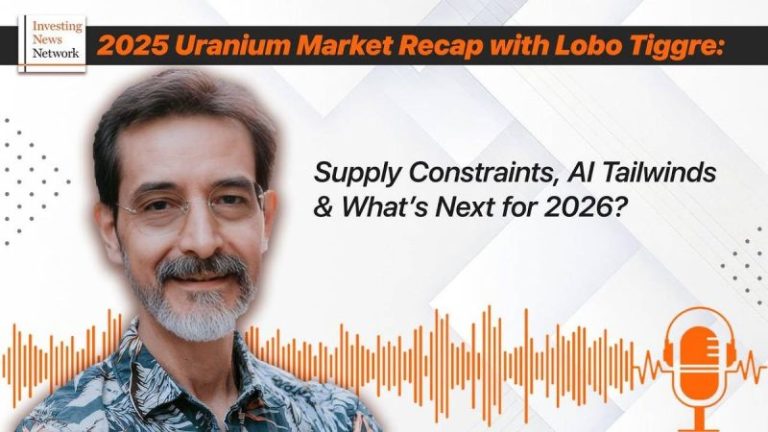
Lobo Tiggre, CEO of IndependentSpeculator.com, described uranium’s key role in providing baseload energy, a narrative that is only being heightened by added artificial intelligence data center and electric vehicle (EV) demand projections.

“The use case is baseload power. There’s no substitution, and the world is building like gangbusters,” he explained. “If the EV story completely went away, it wouldn’t undo the thesis for uranium, It would remove a tailwind, not the base story.”

Securities Disclosure: I, Georgia Williams, hold no direct investment interest in any company mentioned in this article.

This post appeared first on investingnews.com

Gold marked a new price milestone on Tuesday (December 23), continuing its record-breaking 2025 run.

The spot price rose as high as US$4,511.83 per ounce, hitting that point at 4:04 p.m. PST.

Gold spot price chart, December 16 to 23, 2025.

The yellow metal’s latest rise caps off what’s been a historic year.

After starting 2025 around US$2,640, gold had risen to the US$3,200 level by April. It stayed within a fairly flat range until the end of August, when it launched higher once again, breaking US$4,300 in mid-October.

Gold took a breather following that move, even falling briefly below US$4,000; however, its retracement was neither as steep nor as long as market watchers expected. It began gaining steam again in mid-November, and took off again in earnest this week, powering higher along with its sister metal silver, which is currently over US$71 per ounce.

Both metals benefit from geopolitical tensions and economic uncertainty, which have been present on a global scale throughout the year. Interest rate cuts from the US Federal Reserve have provided support too, as have expectations of easier monetary policy after Fed Chair Jerome Powell’s term ends next year.

Gold also continues to benefit from strong central bank buying, while silver’s industrial side is attracting attention. Although it is valued as an investment metal, it’s key for technology such as solar panels.

Elsewhere in the precious metals space, platinum rose to a fresh record on Tuesday, reaching US$2,355.83 per ounce. Palladium remains below its top price level, but is elevated at around US$1,895 per ounce.

Securities Disclosure: I, Charlotte McLeod, hold no direct investment interest in any company mentioned in this article.

This post appeared first on investingnews.com

Artificial intelligence (AI) has cemented its role as a key sector for investors, but its path forward is shifting.

Several catalysts, including sustained AI infrastructure spending and US Federal Reserve interest rate cuts, are poised to drive tech sector growth in 2026; however, massive capital expenditure digestion by hyperscalers, alongside increasing demands for a return on investment and persistent power supply limitations, are influencing a rotation in focus, with risks like high valuations and policy uncertainty potentially capping AI industry gains.

Overall, experts are calling for the technology sector to navigate a delicate balance between aggressive expansion and necessary financial discipline in 2026, with AI at the heart of these matters.

Capex digestion and AI verticalization

AI capital expenditures by hyperscalers are projected to fuel demand for semiconductors, data centers and related infrastructure in the year head, as per Nicholas Mersch, portfolio manager at Purpose Investments.

According to notes from multiple analysts, the Big Four — Meta Platforms (NASDAQ:META), Microsoft (NASDAQ:MSFT), Alphabet (NASDAQ:GOOGL) and Amazon (NASDAQ:AMZN) — are slated to spend over US$300 billion on AI infrastructure. Mersch cited forecasts that see hyperscaler capex hitting roughly US$600 billion in 2026.

“Over the next 12 to 24 months, the narrative likely shifts from who can build fastest to who can drive the highest revenue and margin per dollar of AI infrastructure,’ Mersch added. “This is where verticalization matters. The companies that can capture the full stack, from silicon to applications, look like they will win.’

His top pick in this arena is Google, followed by Microsoft.

While the cloud layer remains a high-stakes game of concentration among a few platforms, Mersch said the hardware layer underneath is beginning to fragment as the chip stack quietly diversifies.

“Large multi-year AI chip deals are broadening the market beyond NVIDIA (NASDAQ:NVDA), with Advanced Micro Devices (NASDAQ:AMD) and custom application-specific integrated circuit (ASIC) programs winning meaningful share. High-bandwidth memory (HBM) has become the real bottleneck and profit pool, with tri-sourced HBM3E, an emerging HBM4 race and surging HBM demand from ASICs,’ the expert said.

‘The result is a more plural, multi-vendor accelerator ecosystem. Looking out to the second half of the decade, total AI silicon spend can keep growing even if individual GPU vendors see more competition and pricing pressure, with memory, packaging and custom silicon capturing a larger share of the economics.’

Chip diversification, however, is now colliding with HBM and packaging shortages, constraining output from 2026 to 2027. BMI’s Cedric Chehab notes that rapid capex growth is outpacing supply, ruling out near-term oversupply, but warns of volatility if data center investments fail to deliver profitability amid persistent infrastructure shortages.

Power as a binding constraint for AI

Power limits are a specter looming above AI expansion heading into 2026.

“Individual campuses are pushing past 1 gigawatt, utilities in key regions are scrambling to add generation and transmission and Big Tech is signing multi-gigawatt nuclear and long-term power deals, including restarts of previously shuttered plants,” explained Mersch. US data center demand is now poised to triple by 2030, thrusting utilities, nuclear operators and grid infrastructure into prime investment orbits.

“Even Google has acknowledged that serving capacity needs to double roughly every six months,” he added.

Alphabet, the parent company of Google, and other hyperscalers became active infrastructure developers in 2025, inking high-profile strategic deals designed to secure 24/7 — and carbon-free — energy for AI data centers.

Google’s deal with Elementl Power in May to provide capital to develop three advanced nuclear sites in the US represents a shift toward nuclear energy that is perhaps the most significant structural change in the AI landscape today, further extending the verticalization narrative into the power grid itself.

The shift toward energy-backed AI is being institutionalized at the highest levels of finance. In late 2025, JPMorgan Chase (NYSE:JPM) launched its US$1.5 trillion Security and Resiliency Initiative, a decade-long plan specifically targeting the intersection of AI, grid infrastructure and nuclear energy.

By earmarking US$10 billion in direct equity for US firms, the initiative effectively underwrites the full-stack transition.

Are AI stocks in a bubble?

The path for AI is moving from building technology to proving its value. While many experts remain optimistic, the transition from deployment to execution introduces new risks that could define the industry’s next winners and losers.

As organizations fully embed AI into their core workflows, the operational stakes are shifting. Infrastructure strategies are diversifying as security-conscious businesses seek more control over their high-value AI workloads.

Simultaneously, the rise of agentic AI, which automates full workflows, combined with cost and complexity issues on major hyperscalers, will lead to a trend of cloud repatriation toward regional and bare-metal platforms.

Despite concerns over a potential bubble, the industry will continue to receive massive institutional backing. B2BROKER’s John Murillo rejects the idea of an AI bubble, comparing OpenAI to Edison’s plants amid giants’ resilience.

‘In the case of dot-coms, everyone was investing just to invest; it didn’t matter what exactly to choose and some of the projects didn’t have a solid foundation. With AI, it’s not like this. The technology proves its worthiness every day, and it has already swept away many junior analysts,’ Murillo emphasized.

Nevertheless, high AI valuations risk corrections if adoption disappoints or energy constraints emerge.

The success of the current capex cycle will depend on whether these investments translate into measurable operating leverage and cost savings through the back half of the decade.

“The bubble scenario is very unlikely,” Murillo added. “I think in the current economic situation, there are problems much worse than a potential bubble.”

For example, geopolitical tensions, sticky inflation and US midterm elections could spark volatility, prompting sector rotations away from overvalued mega caps.

Investor takeaway

The investment focus in AI is shifting from the initial narrative to tangible execution and quantifiable profitability. While the challenges of elevated valuations and geopolitical instability persist, some experts dismiss comparisons to a technology bubble, arguing the sector’s demonstrated value offers a stable underpinning.

Future leaders in the AI industry will be distinguished by their capacity to convert infrastructure spending into significant operating leverage and cost efficiencies.

Securities Disclosure: I, Meagen Seatter, hold no direct investment interest in any company mentioned in this article.

This post appeared first on investingnews.com